



The U.S. EB-5 Immigrant Investor Program continues to attract investors seeking a pathway to permanent residency in the United States. Yet in 2026, investors face a market shaped by changing processing trends, increased scrutiny in project selection, and growing uncertainty surrounding the period beyond September 30, 2026.
To better understand the realities of today’s EB-5 landscape, The Immigration Magazine sat down with Sam Udani, CEO of ILW.COM & Immigration Daily for a discussion on investor risks, project evaluation, processing timelines, and what prospective applicants should be considering right now.
Understanding the EB-5 Process Today
Editor: For many investors around the world, the EB-5 process can seem complicated and overwhelming. Could you walk us through the process in a simple and practical way?
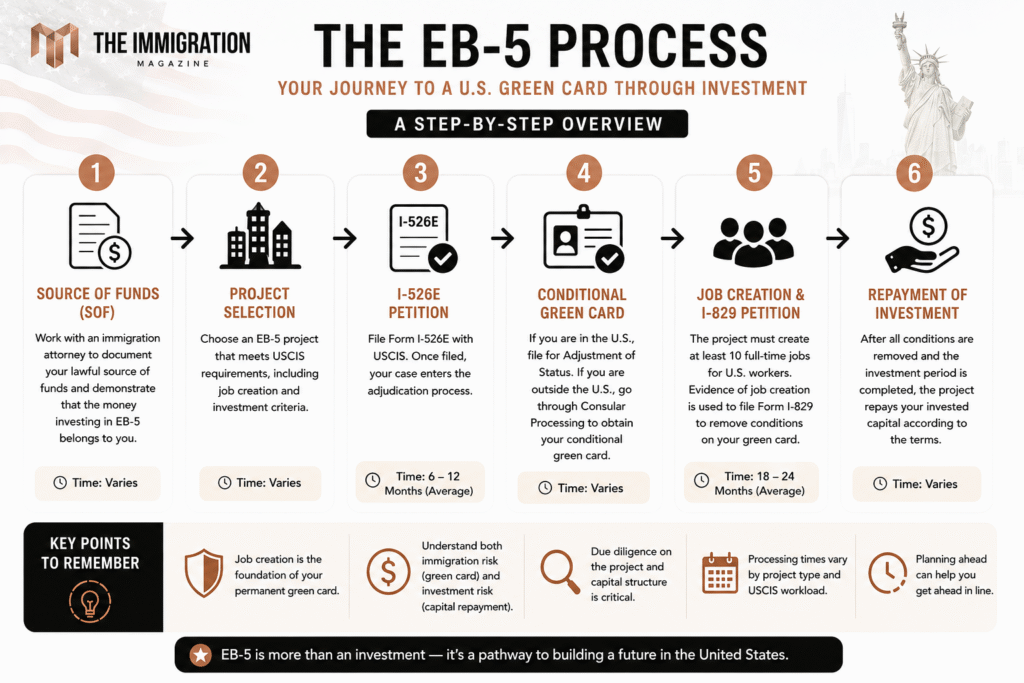
Sam Udani: Once an investor decides to apply for EB-5, the first step is to work with an immigration attorney on the source of funds documentation. Investors must demonstrate that the money being invested belongs to them and explain how it was obtained.
The second step is selecting an EB-5 project.
Once the application is filed, investors can generally expect an approval within approximately six to twelve months.
If the investor is already in the United States, they may apply for Adjustment of Status. If they are outside the country, they will typically proceed through Consular Processing to obtain a conditional Green Card.
The next stage is job creation. The project must demonstrate that the required jobs have been created, and that information is used when filing the investor’s petition to remove conditions and obtain permanent residency.
After that, the investor’s capital may be repaid according to the terms and timeline of the project.
The Biggest Risks Investors Should Watch?
Editor: Before selecting a project, what are the most important risks investors should pay attention to?
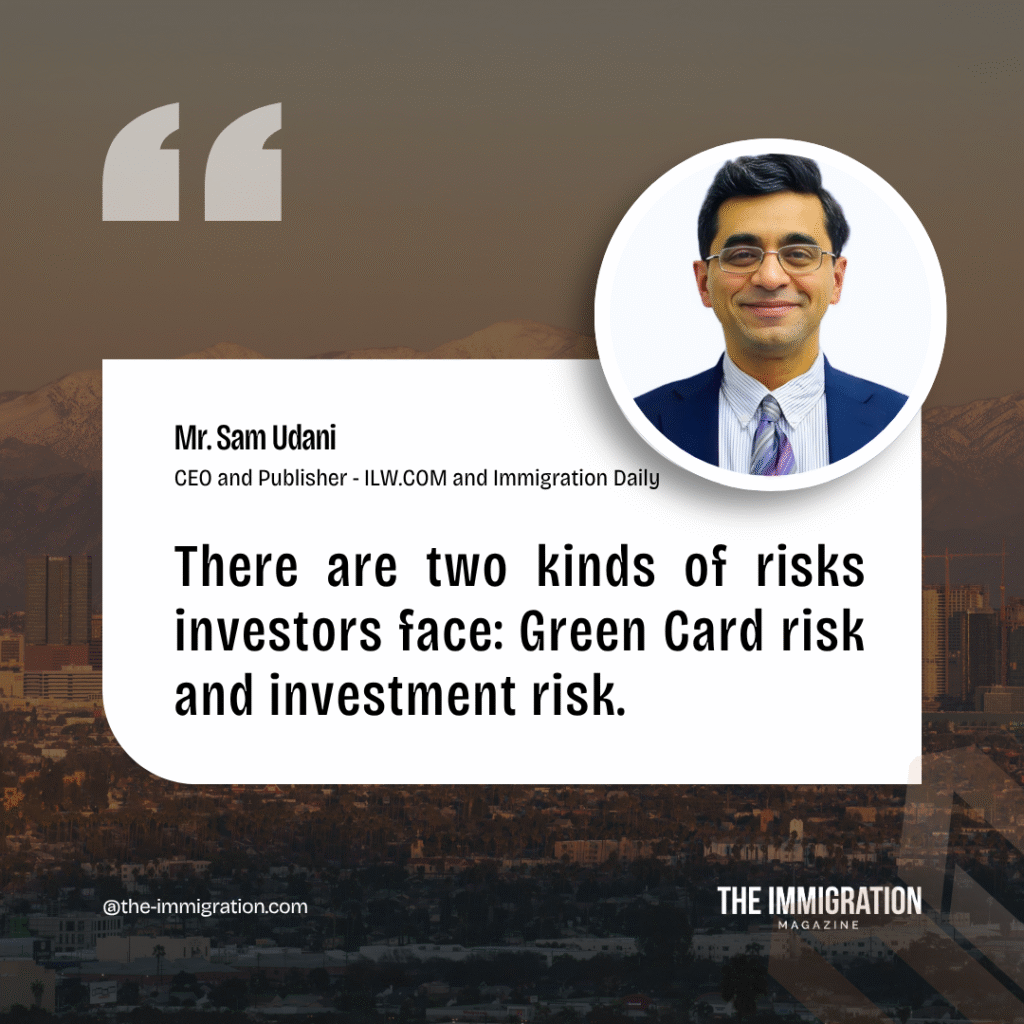
Sam Udani: There are two main risks: Green Card risk and investment risk.
Green Card risk is based on the certainty—or uncertainty—of job creation. Since most investors pursue EB-5 to obtain permanent residency, this is usually the most important risk they face.
Investment risk is based on the likelihood that the investor’s money will ultimately be repaid.
Investors should understand that these are two separate issues, and both deserve careful consideration.
How to Evaluate a Good EB-5 Project?
Editor: Project selection is one of the most important decisions in the EB-5 journey. What factors should investors focus on when evaluating a project in 2026?
Sam Udani: Securing your Green Card should be the primary objective, which means paying close attention to job creation.
If the jobs are not created, the investor risks losing the immigration benefit.
The second consideration is protecting your investment.
Investors should examine whether their EB-5 investment is backed by a mortgage, a deed of trust, or another form of security—or whether it is unsecured.
Even if a project is successful, it does not necessarily mean investors will get their money back.
It is also important to understand where EB-5 capital sits within the capital stack. The first half of the capital stack is generally safer than the second half because those in senior positions, such as banks, are repaid first.
If EB-5 capital sits behind a large senior loan, repayment risk can increase significantly.
Processing Time Expectations in 2026
Editor: Processing times remain a major concern for investors globally. What is the realistic expectation today, and are some categories moving faster than others?
Sam Udani: Yes.
Currently, Rural EB-5 projects are moving significantly faster than urban High Unemployment Area (HUA) projects.
Average processing times for Rural EB-5 petitions are around six months, while HUA projects are closer to eighteen months.
There is another factor investors should keep in mind.
As we approach the September 30, 2026 deadline, we are likely to see a significant increase in EB-5 applications.
Investors who intend to move forward may want to file sooner rather than later in order to get ahead of that wave of new applications, which could result in longer processing times across all categories.
Key Advice for Investors Considering EB-5?
Editor: For investors evaluating EB-5 opportunities today, what would be your key advice?
Sam Udani: I would focus on four things.
First, consider Rural EB-5 projects because of their shorter processing times.
Second, if you are planning to pursue EB-5, consider acting sooner rather than later to avoid delays caused by a surge in new filings.
Third, look for projects with strong job buffers. A higher job buffer can help reduce the risk of falling short on job creation requirements.
Finally, a sponsor’s track record should not be the only factor used to evaluate a project.
Past performance is important, but investors should also examine the specific project’s structure, job creation assumptions, and capital protection.
The Future of EB-5 Beyond September 30, 2026?
Editor: Looking ahead, what do you see as the biggest issue facing the EB-5 industry over the next few years?
Sam Udani: The biggest issue is the uncertainty surrounding September 30, 2026.
At the moment, everyone has visibility up to that date because the grandfathering provisions under the Reform and Integrity Act are scheduled to expire.
What happens after that remains uncertain.
No one can predict with confidence what the legislative environment will look like beyond September 2026.
We also cannot assume that Congress will act quickly. Historically, the Regional Center Program has been allowed to expire before being renewed.
For investors who already know they want to pursue EB-5, it may be prudent to act while the current framework remains in place.
As the industry approaches a potentially significant deadline, investors face a combination of opportunities and uncertainties.
This discussion highlights several recurring themes: the importance of job creation, the need to evaluate both immigration and investment risk, the processing advantages currently available in Rural EB-5 projects, and the uncertainty surrounding the future of the program after September 30, 2026.
For prospective applicants, careful due diligence and timely planning may be more important than ever.
About Sam Udani
Sam Udani has more than 34 years of experience in the U.S. legal and immigration industry. His work has focused on immigration law education, legal publishing, and investor migration, making him a widely recognized voice within the EB-5 community.