


Vietnam has rapidly emerged as one of Asia’s most strategically important destinations for foreign direct investment, attracting growing interest from international entrepreneurs, multinational corporations, and global investors seeking long-term expansion opportunities in Southeast Asia.
As Vietnam continues strengthening its position within global supply chains and accelerating its economic integration, the country is increasingly viewed not only as a manufacturing hub but also as a key strategic market for regional growth and international business development.
In this exclusive interview, The Immigration Magazine speaks with David Lam, a respected expert in foreign investment and business advisory in Vietnam, to explore the realities of entering the Vietnamese market in 2026, including legal structures, taxation, regulatory considerations, emerging investment sectors, and the strategic challenges foreign investors should prepare for in an evolving economic landscape.
Vietnam’s Competitive Position in the Regional Investment Landscape
According to David Lam, Vietnam’s growing appeal among international investors is driven by a combination of political stability, strategic geopolitical positioning, competitive labor costs, and a young workforce that is increasingly integrated into the global economy.
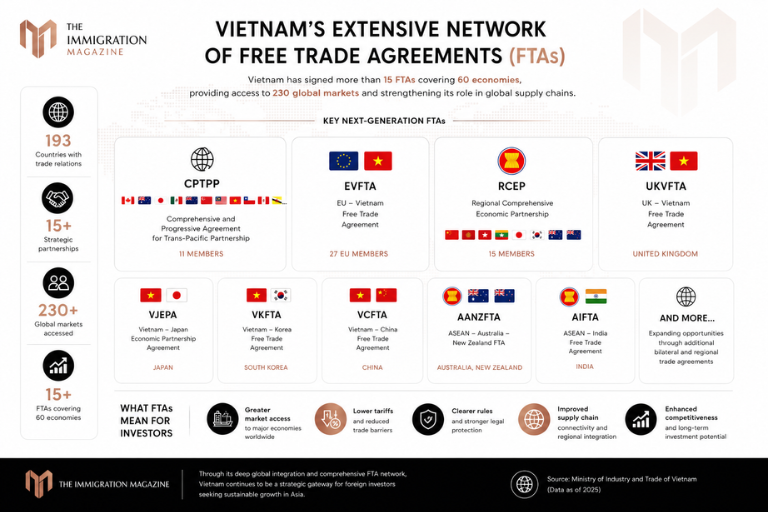
He emphasizes that Vietnam’s extensive network of next-generation free trade agreements, particularly the CPTPP and the EU–Vietnam Free Trade Agreement (EVFTA), has substantially improved market accessibility while strengthening the country’s role within global supply chains.
Beyond its manufacturing advantages, Vietnam is also emerging as a significant player in international trade. The country currently maintains trade relations with 193 countries, alongside 15 strategic partnerships, and enjoys access to more than 230 global markets through over 15 free trade agreements covering approximately 60 economies. In 2025, Vietnam ranked among the world’s top 15 trading nations, reflecting the scale of its expanding export capacity and deepening global economic integration.
David Lam further notes that, compared to several regional markets, Vietnam continues to distinguish itself through investor-oriented policies, ongoing regulatory reforms, and sustained growth in disbursed foreign direct investment. Together, these factors are reinforcing Vietnam’s position as one of Asia’s most competitive destinations for long-term international investment.
Navigating the Investment Process in Vietnam
David Lam explains that, while Vietnam’s investment framework may initially appear complex to foreign investors, the legal process has become increasingly structured and flexible in recent years.
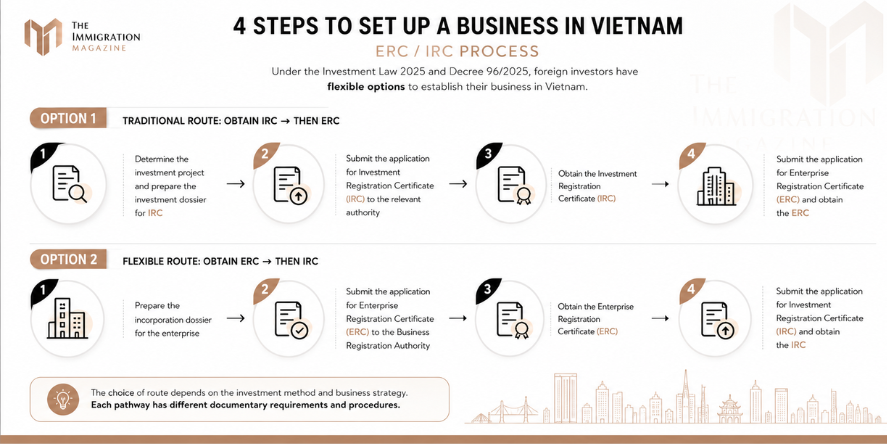
In general, establishing a business in Vietnam involves several key stages, including determining the appropriate legal structure, preparing the incorporation documents, submitting the application to the relevant licensing authorities, and obtaining the Enterprise Registration Certificate (ERC).
Traditionally, foreign investors were required to secure an Investment Registration Certificate (IRC) prior to establishing a company. However, under Vietnam’s updated Investment Law 2025 and Decree 96/2025, investors are now afforded significantly greater procedural flexibility.
Depending on the investment structure and business objectives, foreign investors may either follow the conventional approach of obtaining the IRC before the ERC or establish the enterprise first and subsequently complete the investment registration process afterward.
According to David Lam, this evolving framework allows international businesses to approach market entry more strategically. In practice, investors are increasingly able to establish a legal presence, negotiate commercial agreements, and prepare operational activities while simultaneously completing project-specific licensing and regulatory procedures.
He further notes that the documentary requirements and approval processes will vary depending on the selected investment pathway, making early legal structuring and regulatory planning particularly important for foreign businesses entering the Vietnamese market.
Choosing the Right Legal Structure for Foreign Investment
According to David Lam, the choice of legal structure in Vietnam depends largely on the investor’s commercial objectives, operational strategy, and the level of control required within the business.
Among the most commonly used structures, the Wholly Foreign-Owned Enterprise (WFOE), typically established in the form of a Limited Liability Company (LLC), remains the preferred option for investors seeking full ownership and independent control over operations, management, and profit distribution.
For sectors subject to foreign ownership limitations or industries where local expertise and established business networks play a critical role, Joint Ventures (JVs) continue to serve as a strategic entry model. In many cases, partnerships with Vietnamese entities can facilitate faster market penetration and operational expansion.
Meanwhile, Representative Offices (ROs) are commonly utilized by foreign corporations seeking to conduct market research, maintain commercial liaison activities, or strengthen brand presence in Vietnam before making a direct investment. However, David Lam emphasizes that Representative Offices are not permitted to engage in revenue-generating business activities under Vietnamese law.
He further notes that there is no universally suitable structure for every investor. The appropriate model will ultimately depend on various factors, including the investor’s long-term objectives, the number of shareholders or participants involved, the nature of the business sector, and the intended investment scale.
Beyond the initial establishment phase, compliance remains a critical consideration for foreign businesses operating in Vietnam. Investors are expected to maintain strict adherence to statutory auditing obligations, local labor and employment regulations, corporate governance requirements, and foreign exchange control procedures, particularly in relation to capital contributions, cross-border fund transfers, and profit remittance activities.
Vietnam’s Tax Environment and Strategic Financial Planning
David Lam explains that understanding Vietnam’s tax framework is a fundamental consideration for foreign investors evaluating market entry opportunities in 2026.
At the core of Vietnam’s corporate taxation system is the standard Corporate Income Tax (CIT) rate of 20%. However, Vietnam continues to offer a range of preferential tax incentives designed to attract foreign investment into strategically important sectors, including high technology, renewable energy, manufacturing, and projects located within designated socio-economic zones. Depending on the nature and scale of the investment, investors may benefit from tax holidays, reduced tax rates, or other investment-related incentives.
In addition to Corporate Income Tax, foreign businesses operating in Vietnam are also subject to Value Added Tax (VAT), which is generally imposed at a standard rate of 10%, although temporary reductions, exemptions, or sector-specific adjustments may apply under certain regulatory policies. Personal Income Tax (PIT) obligations for both local employees and expatriate personnel also remain an important component of operational tax planning.
Beyond the headline tax rates, David Lam notes that foreign investors entering Vietnam in 2026 must pay increasing attention to transfer pricing compliance and cross-border transaction structures.
Vietnamese tax authorities are applying significantly greater scrutiny to intercompany transactions, related-party pricing mechanisms, and international supply chain arrangements. As a result, investors are expected to ensure that all transfer pricing practices strictly comply with arm’s-length principles and are supported by comprehensive documentation and transparent reporting standards.
According to David Lam, proactive tax structuring and early compliance planning are becoming increasingly important for international businesses seeking to operate efficiently and sustainably within Vietnam’s evolving regulatory environment.
Common Risks and Strategic Mistakes Foreign Investors Should Avoid
According to David Lam, one of the most common misconceptions among foreign investors entering Vietnam is the assumption that obtaining the Enterprise Registration Certificate (ERC) and Investment Registration Certificate (IRC) automatically allows a business to commence full operations immediately.
In practice, many industries in Vietnam remain subject to conditional business requirements, meaning that additional sub-licenses, sector-specific approvals, or operational permits may still be required after the initial incorporation process is completed. Failure to anticipate these post-licensing procedures can result in significant operational delays and disruptions to market entry timelines.
Another critical area of risk involves Vietnam’s foreign exchange control regulations. David Lam notes that many foreign investors underestimate the importance of properly structuring capital contribution accounts and maintaining strict compliance with banking and remittance procedures.
Improper handling of investment capital, particularly the misuse or confusion between capital accounts and operational current accounts, can create substantial legal and financial complications later, especially when companies seek to remit profits abroad or repatriate investment capital.
Beyond regulatory and financial compliance, Intellectual Property (IP) protection also remains a major concern for international businesses entering the Vietnamese market.
While Vietnam follows the internationally recognized “first-to-file” principle, David Lam highlights that trademark squatting continues to be a highly practical and frequently overlooked risk. Many foreign brands mistakenly rely on their existing international reputation and postpone local trademark registration until they are ready to officially launch operations in Vietnam.
By that stage, local entities may have already registered identical or substantially similar trademarks, potentially forcing foreign investors into costly acquisition negotiations, prolonged legal disputes, or even complete brand repositioning within the market.
For this reason, David Lam emphasizes that proactive local Intellectual Property registration should be treated as an essential pre-market entry strategy rather than a post-launch administrative step.
Emerging Industries Driving Vietnam’s Next Phase of Growth
According to David Lam, Vietnam’s investment landscape in 2026 is being increasingly shaped by sectors aligned with global supply chain transformation, technological innovation, and long-term sustainability objectives.
Among the most prominent areas of growth, high-tech manufacturing continues to attract substantial international attention, particularly in semiconductors, electronic components, and advanced industrial production. As multinational corporations continue diversifying manufacturing capacity across Asia, Vietnam is strengthening its position as a strategic destination within the global technology supply chain.
David Lam also highlights renewable energy as one of the country’s most promising long-term investment sectors. Driven by Vietnam’s commitment to its COP26 climate objectives and the growing national demand for sustainable infrastructure, the sector is expected to remain a major area of both domestic and foreign investment in the years ahead.
Beyond industrial development, Vietnam’s rapidly expanding digital economy is creating significant opportunities across e-commerce, fintech, and LegalTech. Supported by a young, digitally connected, and increasingly affluent middle class, these sectors are experiencing accelerated growth and attracting rising levels of venture capital and international strategic investment.
At the same time, high-end logistics and industrial real estate continue to play a critical role in supporting Vietnam’s manufacturing expansion and export-driven economy. As global supply chains become more deeply integrated into Southeast Asia, demand for industrial infrastructure, warehousing, and logistics networks across Vietnam is expected to remain exceptionally strong.
Vietnam’s Position as a Long-Term Strategic Market
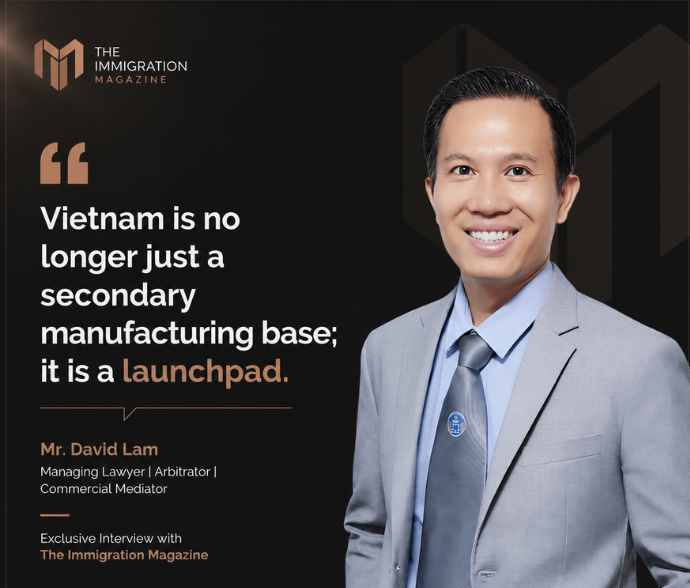
From a broader strategic perspective, David Lam believes Vietnam has evolved far beyond its historical image as a low-cost manufacturing destination.
Instead, the country is increasingly establishing itself as a high-value and strategically important node within global supply chains. For international entrepreneurs and long-term investors, Vietnam is no longer viewed merely as an alternative production base, but rather as a gateway to broader regional expansion.
According to David Lam, establishing a strong commercial presence in Vietnam provides investors with strategic access to the wider ASEAN market, a regional economic bloc representing more than 600 million consumers and one of the world’s fastest-growing economic regions.
As global businesses continue reassessing supply chain resilience, regional diversification, and long-term growth opportunities across Asia, Vietnam is becoming an increasingly central component of international expansion strategies.
The Future of Foreign Investment in Vietnam
Looking ahead over the next several years, David Lam believes Vietnam’s foreign investment environment will continue to evolve toward a more sophisticated, transparent, and strategically regulated framework.
According to him, investors entering the Vietnamese market must be prepared to navigate the newly implemented provisions under the 2025 Investment Law. While the updated framework is designed to streamline some administrative and investment procedures, it also introduces more rigorous review mechanisms relating to project feasibility, regulatory transparency, and national security considerations in strategically sensitive sectors.
As Vietnam continues attracting larger volumes of foreign capital and deeper international integration, regulatory expectations for foreign-invested enterprises are also becoming increasingly comprehensive.
Beyond investment regulation, David Lam highlights data privacy and digital compliance as emerging areas of major importance for international businesses operating in Vietnam.
Following the introduction of Vietnam’s comprehensive data protection regulations in 2025, companies handling customer information, digital platforms, or cross-border data transfers are now subject to significantly stricter compliance obligations. Foreign investors operating within technology-driven industries, e-commerce, fintech, digital services, or data-intensive business models will need to strengthen their internal governance systems and compliance frameworks to align with these evolving regulatory standards.
According to David Lam, the direction of Vietnam’s legal and economic environment reflects the country’s broader ambition to position itself as a mature and globally integrated investment destination capable of supporting long-term, high-value international business activity.
Final Reflections
Vietnam continues to stand among the most dynamic and strategically important investment destinations in Asia. However, successful market entry increasingly requires far more than capital alone. Long-term success in Vietnam depends on careful legal structuring, strategic planning, regulatory preparedness, and a strong understanding of the local business environment.
The Immigration Magazine thanks David Lam for sharing his insights and professional perspectives on the evolving investment landscape in Vietnam.
For more expert commentary on global investment, international business strategy, and cross-border mobility, stay connected with The Immigration Magazine.
About Mr. David Lam
Mr. Nguyen Ngoc Lam (David Lam) is a Vietnamese legal professional with over 18 years of experience in Corporate & Commercial Law, with a strong focus on foreign investment, energy, construction, maritime, and infrastructure projects.
He currently serves as a Managing Lawyer, Arbitrator, and Commercial Mediator, and has advised multinational corporations and major enterprises across a wide range of complex commercial matters, including M&A, EPC projects, dispute resolution, logistics, and cross-border investment.
David Lam is also an Arbitrator at the Ho Chi Minh City Commercial Arbitration Center (TRACENT) and an accredited Commercial Mediator at the Vietnam International Commercial Mediation Center (VICMC). In addition to his legal practice, he is actively involved in corporate governance, international legal associations, and professional education, frequently contributing as a speaker, mentor, and lecturer at industry forums and academic institutions.
His professional philosophy is grounded in the belief that legal expertise should not only ensure compliance but also create long-term strategic value for businesses.