



When international families expand their global footprints, their primary focus often centers on acquiring premium passports or securing long-term residence permits. In the vocabulary of global mobility, “citizenship” and “residency” are frequently used interchangeably.
However, in 2026, conflating these two distinct legal pillars represents a significant risk to international wealth structuring.
An alternative passport grants political rights and geographical mobility, but it does not automatically determine where you owe fiscal obligations. Conversely, a residency permit can inadvertently pull your worldwide assets into a progressive tax net without ever granting you a second nationality.
At The Immigration Magazine, we deconstruct the strategic distinctions between Tax Residency and Citizenship to help affluent families decouple their lifestyle mobility from structural tax exposure.
1. The Core Legal Distinctions
To manage cross-border assets effectively, family offices must treat citizenship and tax residency as independent variables within a broader governance framework.
Citizenship: The Sovereign and Permanent Bond
Citizenship represents a permanent legal relationship between an individual and a sovereign state. It is governed by constitutional law and is generally immutable unless voluntarily renounced or revoked under exceptional statutory conditions.
- Core Rights: It grants a non-negotiable right of entry, political participation (voting), and the protection of the issuing state’s consular network.
- Fiscal Link: With the notable exceptions of the United States and Eritrea, which enforce citizenship-based taxation, the vast majority of global nations do not tax individuals solely based on the passport they hold.
Tax Residency: The Fluid and Operational Metric
Tax residency is a purely administrative classification determined by domestic tax codes and international treaties. It dictates which sovereign state has the right to tax an individual’s global or localized income within a given financial year.
- Core Characteristic: It is highly fluid and can change annually based on physical presence, behavioral metrics, and economic connections.
- Fiscal Link: Becoming a tax resident in a standard jurisdiction typically exposes your worldwide income and foreign assets to the host country’s regulatory and tax frameworks.
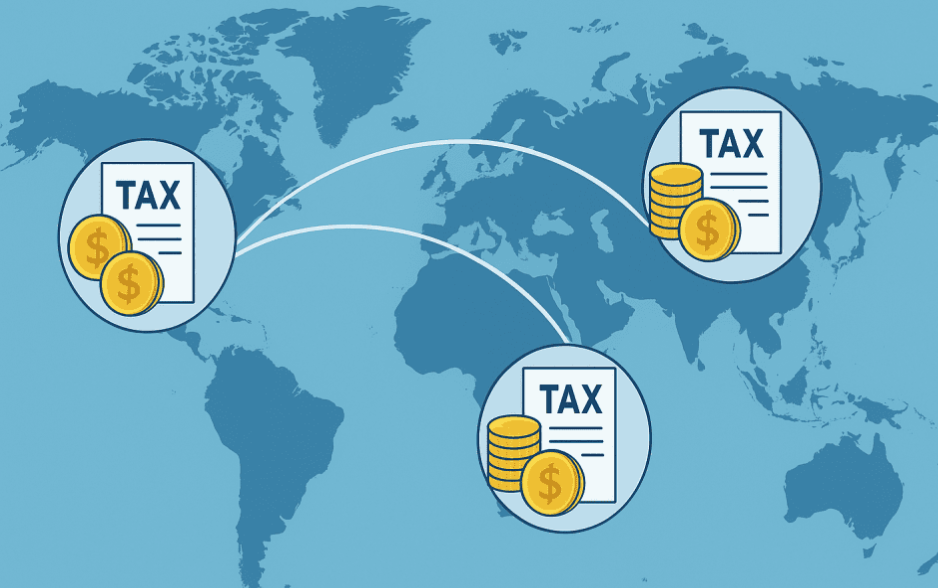
2. The Primary Triggers of Tax Residency: The 183-Day Rule and Beyond
While citizenship is obtained through lineage, naturalization, or approved direct investment, tax residency is frequently triggered automatically through day-counting or economic alignment.
The 183-Day Rule
The most standardized metric globally is the physical presence test. Spending 183 days or more within a calendar year inside a country’s borders typically establishes automatic tax residency. HNWIs managing multiple properties across Europe, Asia, and the Americas must carefully monitor their travel schedules to avoid accidentally triggering multiple concurrent tax residencies.
The Center of Vital Interests (CVI)
Under modern transparency standards, physical presence is no longer the sole metric. Double Taxation Treaties (DTTs) utilize “tie-breaker rules” to determine a single tax home if an individual maintains ties to multiple states. Tax authorities evaluate:
- Where the individual’s permanent family home is maintained.
- The jurisdiction where the primary source of active economic income or corporate management is concentrated.
- Where the individual’s personal and social habits are habitually anchored.
3. Strategic Allocation: Decoupling Mobility from Tax Exposure
For the global elite, the optimal deployment of investment migration programs involves utilizing the structural differences between citizenship and tax residency to maximize resilience.
Scenario A: Mobility Without Fiscal Friction
An investor acquires a secondary citizenship through an institutional framework (such as Malta’s MEIN or an evolved Caribbean structure). This provides a permanent “Plan B” and enhanced global mobility. However, because the investor continues to maintain their physical presence and primary economic operations in a territorial tax jurisdiction like Singapore, their global portfolio remains insulated from the progressive tax rates of the passport-issuing state.
Scenario B: Intentional Fiscal Relocation
An active remote entrepreneur utilizes Spain’s Digital Nomad Visa to secure residency. Recognizing that they will spend over 183 days in the country, they proactively apply for the specialized expatriate tax regime (the “Beckham Law”). This ensures that while their physical residency is established in Southern Europe, their non-Spanish source passive income remains managed under a more predictable, flat-rate framework rather than the standard progressive tax brackets.
4. Strategic Positioning Matrix: Managing the Dual-Pillar Framework

Strategic Dimension | Citizenship Framework | Tax Residency Framework |
Legal Basis | Constitutional law & sovereign nationality | Domestic tax codes & bilateral tax treaties (DTTs) |
Duration | Permanent and transmissible to future generations | Fluid; reassessed annually based on behavior and stay |
Primary Benefit | Unconditional right of entry, political security, mobility | Access to local public infrastructure, treaty relief benefits |
Primary Financial Risk | Negligible (except for US citizens subject to FATCA) | High exposure to worldwide progressive income taxes and reporting |
Operational Control | Established via birth, marriage, or structured investment | Managed via strict day-counting, logbooks, and asset placement |
Final Thoughts: The Compliance Imperative
As international transparency initiatives like the Common Reporting Standard (CRS) and automated financial information-sharing networks become more sophisticated, the ability of tax authorities to cross-reference an individual’s passport data with their financial accounts has reached unprecedented levels.
At The Immigration Magazine, our strategic perspective remains clear: structuring a global lifestyle requires separating the emotional desire for a second passport from the mathematical reality of your tax residency. Acquiring multiple citizenships enhances your family’s long-term geopolitical optionality and physical safety. However, protecting your generational wealth requires managing your physical movements and economic substance with absolute precision. True jurisdictional resilience is achieved when your citizenship profile provides maximum freedom, while your tax residency baseline ensures long-term regulatory predictability.
Data & Source References:
- OECD Center for Tax Policy: Model Tax Convention on Income and on Capital (Article 4: Resident and Tie-Breaker Rules).
- The Common Reporting Standard (CRS): Global Implementation Guidelines for Financial Account Information Rules.
- Internal Revenue Service (IRS): Revenue Procedures on Expatriation and Citizenship-Based Tax Compliance (IRC Section 877A).
Follow us on social media and website for more insights!