

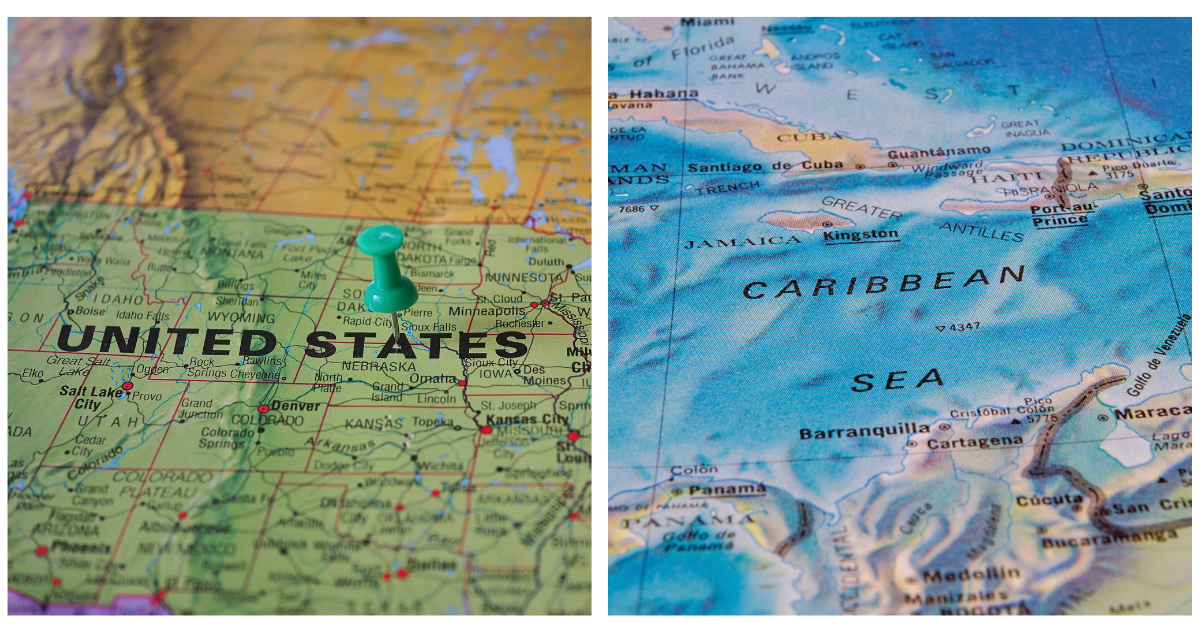
For investors considering a second residency or citizenship, Rural EB-5 and Caribbean Citizenship by Investment (CBI) represent two fundamentally different strategies.
Rural EB-5 is designed for families seeking long-term residence in the United States, while Caribbean CBI is generally better suited to investors seeking a second citizenship, greater mobility, and flexibility without permanent relocation.
The right choice therefore depends less on which program is “better” and more on the investor’s priorities, budget, timeline, and long-term plans.
1. The Fundamental Difference: Green Card vs. Citizenship
The first distinction is what each route actually provides.
Rural EB-5: A Pathway to U.S. Permanent Residence
The EB-5 Immigrant Investor Program allows qualifying investors, their spouses, and unmarried children under 21 to pursue U.S. permanent residence.
The minimum investment is currently $800,000 for qualifying Targeted Employment Area (TEA) projects, including rural projects. Under the EB-5 Reform and Integrity Act (RIA), 20% of annual EB-5 visas are reserved for qualifying rural investments, and USCIS gives rural petitions priority processing.
For eligible applicants already legally present in the United States, concurrent filing of Form I-526E and Form I-485 may also be available when a visa number is immediately available.
In practical terms, EB-5 is most relevant to families that genuinely intend to live, study, work, or establish a long-term future in the United States.
Caribbean CBI: Direct Second Citizenship
Five Eastern Caribbean countries currently operate established CBI programs:
Antigua & Barbuda, Dominica, Grenada, St. Kitts & Nevis, and Saint Lucia.
These programs provide qualifying investors with citizenship rather than permanent residence.
Following regional reforms, participating countries adopted a minimum investment pricing standard of $200,000, although actual minimum contributions, investment options, government fees, and family costs vary by jurisdiction.
Caribbean CBI is therefore primarily a second-citizenship and mobility solution, rather than a pathway requiring the investor to relocate permanently.

2. Budget: $800,000 vs. $200,000+
The difference in capital commitment is significant.
For Rural EB-5, the qualifying investment threshold is $800,000, excluding legal, administrative, filing and project-related fees. Importantly, EB-5 capital must remain at risk under U.S. immigration requirements.
Unlike a government contribution, the investment may potentially be repaid according to the project’s terms and performance. However, capital repayment is not guaranteed.
Caribbean CBI generally requires substantially less capital. Depending on the country and chosen route, applicants may make a non-refundable government contribution or invest in another qualifying asset, such as approved real estate.
The $200,000 figure should be viewed as a regional minimum pricing standard, rather than the price of every Caribbean CBI program.
3. Processing and Mobility
Caribbean CBI generally offers the faster route because successful applicants proceed directly toward citizenship and passport issuance. Actual processing times vary according to the country, applicant profile, nationality, and due-diligence requirements.
Rural EB-5 involves a longer immigration process. Although rural petitions receive statutory priority processing, USCIS does not guarantee approval within a fixed period.
The trade-off is significant: successful EB-5 applicants obtain U.S. permanent residence, providing the right to live, work and study throughout the United States.
This makes the comparison relatively straightforward:
Caribbean CBI prioritizes mobility. Rural EB-5 prioritizes U.S. residence.
4. Long-Term Considerations
The two routes also create very different long-term obligations.
A U.S. Green Card is intended for individuals making the United States their permanent home. Extended periods outside the country can create immigration issues, while becoming a U.S. permanent resident also brings important U.S. tax and reporting implications.
Caribbean citizenship generally offers greater geographic flexibility. Investors are not necessarily expected to make the issuing country their primary home, although individual program requirements vary.
Importantly, obtaining Caribbean citizenship does not automatically change an investor’s tax residence. Tax residency is determined separately under the applicable domestic laws and tax treaties.

5. Rural EB-5 vs. Caribbean CBI at a Glance
Rural EB-5 | Caribbean CBI | |
Outcome | U.S. permanent residence | Citizenship |
Minimum Capital | $800,000 | $200,000 regional pricing floor; actual costs vary |
Capital Structure | At-risk investment | Contribution or qualifying investment |
Processing | Longer; rural petitions receive priority | Generally faster |
Primary Benefit | Live, work and study in the U.S. | Second citizenship & mobility |
Relocation | Designed for U.S. residence | Generally no permanent relocation |
Tax Consideration | U.S. permanent residence has significant tax implications | Citizenship alone does not determine tax residency |
Best For | Families building a future in the U.S. | Investors prioritizing flexibility and second citizenship |
Which Route Is Right for You?
Rural EB-5 may be more suitable if your family intends to relocate to the United States, your children plan to study or build careers there, and you are comfortable committing $800,000 to an at-risk investment in exchange for a pathway to permanent residence.
Caribbean CBI may be more suitable if your priority is obtaining a second citizenship with a lower capital commitment, greater international mobility, and limited relocation requirements.
Grenada offers an additional consideration. As an E-2 treaty country with the United States, Grenadian citizens may be eligible to apply for a U.S. E-2 Treaty Investor visa if they separately make a substantial investment in a qualifying U.S. business and meet other requirements. E-2 is a non-immigrant visa and should not be considered equivalent to the permanent residence provided through EB-5.
Conclusion
Rural EB-5 and Caribbean CBI solve different problems.
EB-5 is primarily about where your family wants to live. Caribbean CBI is primarily about what additional citizenship and mobility options your family wants to hold.
For investors planning a long-term future in the United States, Rural EB-5 offers a direct permanent residence pathway. For those prioritizing a second passport, geographic flexibility and a lower capital commitment, Caribbean CBI may be the more appropriate option.
The decision should ultimately be based on family objectives, capital tolerance, relocation plans, and long-term tax considerations rather than speed or investment amount alone.
Follow us on social media and website for more insights!