

In the globalized economy of 2026, investors have more options than ever before. However, as capital moves across borders with the click of a button, it is essential to remember that not all investments serve the same purpose.
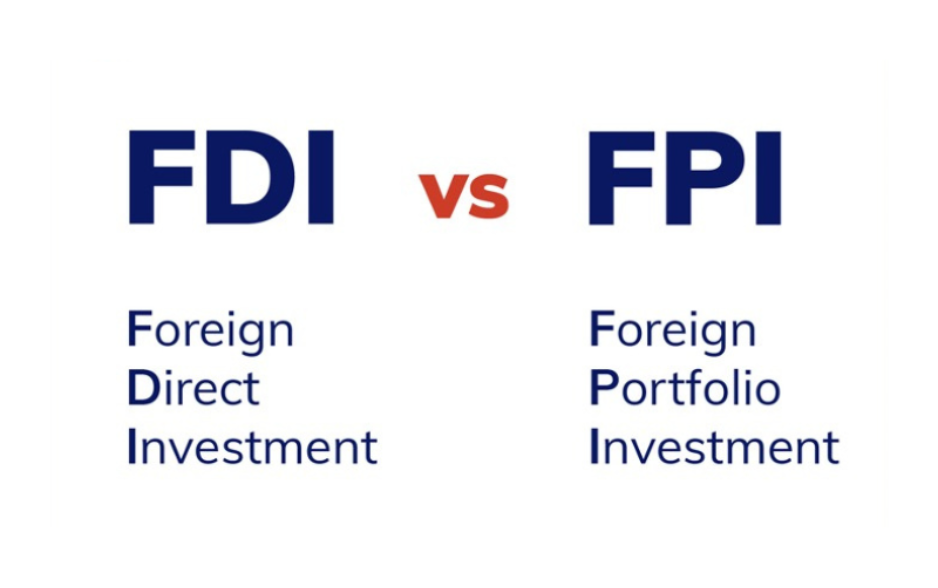
When moving your wealth into international markets, you will face two primary paths: Foreign Direct Investment (FDI) and Foreign Portfolio Investment (FPI). While both involve putting capital into a market, they operate in fundamentally different ways. For a global citizen, understanding this distinction is the first step toward building a successful international strategy.
1. Simple Definitions: FDI and FPI
Before diving into the strategic details, let’s define these two terms in their simplest form:
- Foreign Direct Investment (FDI): This is a “hands-on” investment. It happens when an investor establishes a lasting interest in a business located in another country. It involves not just sending money, but also taking a significant role in managing or controlling the business.
- Foreign Portfolio Investment (FPI): This is a “hands-off” investment. It involves purchasing financial assets, like stocks or bonds, in another country. The investor’s goal is usually a financial return rather than active management or control of the company.
A Simple Analogy: Foreign Direct Investment (FDI) is like building and running a house, where you manage the property and stay for years. Foreign Portfolio Investment (FPI) is like renting a hotel room; you pay for the stay and enjoy the benefits, but you can leave whenever you like without any responsibility for the building.
2. Control vs. Flexibility
One of the clearest differences between these two approaches is the level of Control.
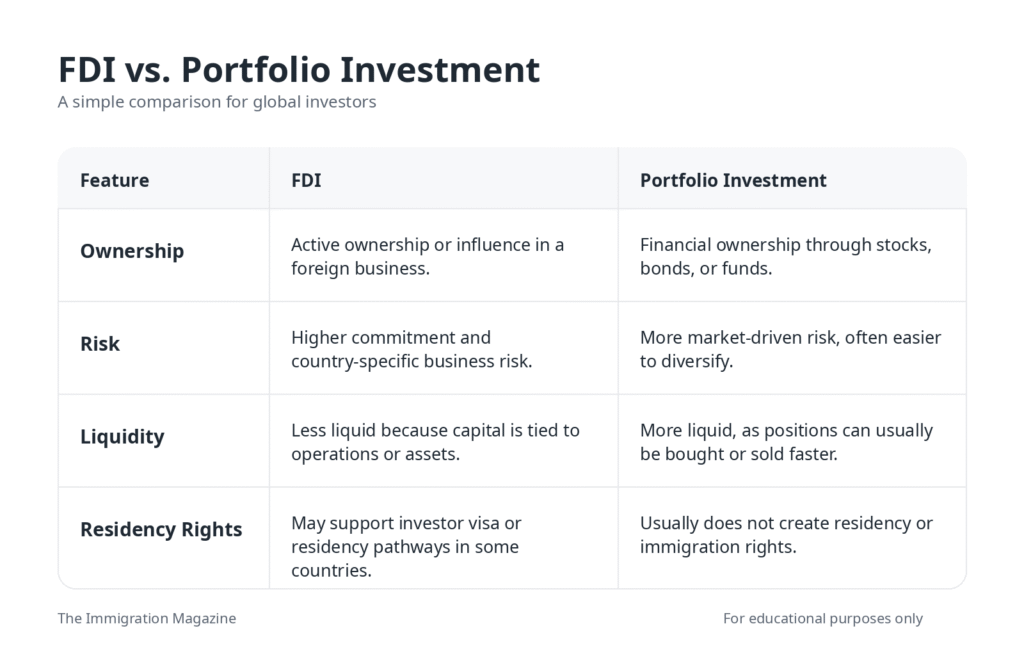
With Foreign Direct Investment (FDI), investors usually seek a level of ownership (typically 10% or more) that allows them to influence decisions. This active role may involve managing local teams, building supply chains, or navigating local regulations. You aren’t just an investor; you are a stakeholder in the country’s growth.
Foreign Portfolio Investment (FPI) offers the opposite advantage: Flexibility. It provides liquidity, allowing investors to enter or exit positions relatively quickly in response to market conditions. You can diversify your wealth across dozens of markets at once without being tied to the operational success of a specific business.
3. Risk and Time Horizon: Patience vs. Agility
The two approaches also have a different relationship with Time.
- The Long-term Commitment of FDI: FDI is a marathon. Because it involves physical assets (factories, offices, or real estate) and human capital, it requires patience and commitment. While the risks can be higher due to setup costs and difficulty in selling assets quickly, the potential for long-term value creation, and regional influence, is far greater.
- The Market Agility of FPI: FPI is more exposed to short-term market volatility. However, its high liquidity allows investors to be agile. In a volatile 2026 market, being able to adjust your positions quickly is a powerful tool for risk management.
4. Why the Difference Matters
In 2026, the distinction between these two approaches has moved beyond simple financial returns. Today’s global investors are thinking about Jurisdiction, Asset Protection, and Global Mobility.
Foreign Direct Investment (FDI) plays a central role in this shift. It connects your capital with a physical presence. Governments in 2026 increasingly favor “sticky capital”, money that stays and builds the economy. As a result, FDI is often the only pathway to Investment Migration (Golden Visas or Residency-by-Investment).
If your goal is to secure a second residency for your family, a portfolio of foreign stocks (FPI) rarely qualifies; you must show the “Economic Substance” that only FDI provides.
5. From Investment to Strategy: The Balanced Approach
For many high-net-worth individuals, the choice between Foreign Direct Investment (FDI) and Foreign Portfolio Investment (FPI) is not an “either-or” decision. Instead, it is about Balance.
A complete global strategy often looks like this:
- FDI as the Foundation: Establish a presence in key markets through direct investment. This supports business expansion, provides asset protection in stable jurisdictions, and secures long-term residency rights.
- FPI as the Engine: Complement your direct holdings with a diversified portfolio of financial assets. This provides the liquidity needed to fund your lifestyle and the agility to capture growth in emerging sectors like AI or Green Energy.
Final Thoughts
Foreign Direct Investment (FDI) and Foreign Portfolio Investment (FPI) represent two different ways of engaging with the world. One is active, long-term, and strategic, providing you with a home and a voice in a new country. The other is flexible, liquid, and diversified, protecting your purchasing power across global markets.
Understanding how they work, and how to combine them, is essential for any investor looking beyond borders. At The Immigration Magazine, we recommend aligning your capital with your lifestyle goals: use Foreign Portfolio Investment (FPI) for your wealth’s growth, and Foreign Direct Investment (FDI) for your family’s future.
Follow us on social media and website for more insights!