

For many years, Vietnam was primarily recognized as a competitive manufacturing destination powered by low labor costs and a young workforce. In 2026, however, the narrative surrounding Vietnam has evolved significantly.
Today, global investors increasingly view Vietnam not merely as a low-cost alternative, but as a strategic regional base within Asia’s shifting economic landscape. High-net-worth individuals (HNWIs), multinational corporations, family offices, and institutional funds are paying closer attention to Vietnam’s long-term role in supply chain diversification, industrial expansion, and regional economic resilience.
As geopolitical fragmentation reshapes global capital allocation, Vietnam has emerged as one of the most closely watched investment destinations in Southeast Asia.
Stability in an Uncertain Global Environment
In 2026, investors are no longer focused solely on chasing returns. Increasingly, global capital prioritizes predictability, diversification, and operational resilience.
One of Vietnam’s strongest advantages is its relatively stable political environment combined with a foreign policy approach often described as “Bamboo Diplomacy.” This strategy allows Vietnam to maintain balanced strategic relationships with major global powers, including the United States, China, the European Union, Japan, and South Korea.
This positioning has helped Vietnam benefit from broader supply chain diversification trends such as the “China+1” strategy, where global manufacturers and investors seek to reduce concentration risk by expanding operations into alternative markets.
Rather than relying on a single geopolitical alignment, Vietnam has positioned itself as a commercially accessible and regionally connected economy capable of engaging with multiple major trading partners simultaneously. For investors, this creates greater flexibility in cross-border trade operations while also supporting long-term access to ASEAN markets and regional growth opportunities.
Vietnam’s FDI Momentum Continues
Vietnam continues to attract substantial foreign direct investment (FDI) inflows across manufacturing, technology, infrastructure, logistics, and renewable energy sectors.
According to Vietnam’s Ministry of Planning and Investment (MPI) and the General Statistics Office (GSO), major foreign investors continue to include Singapore, South Korea, Japan, China, and Hong Kong. More importantly, Vietnam is not only attracting new investment commitments; many multinational corporations are also expanding existing operations. For experienced investors, reinvestment is often considered a stronger indicator of market confidence than first-time entry alone.
This trend reflects growing confidence in Vietnam’s manufacturing ecosystem, export capacity, industrial infrastructure, and long-term regional positioning.
The Legal Environment: Regulatory Modernization
For sophisticated investors, legal predictability and administrative transparency are becoming increasingly important components of investment strategy.
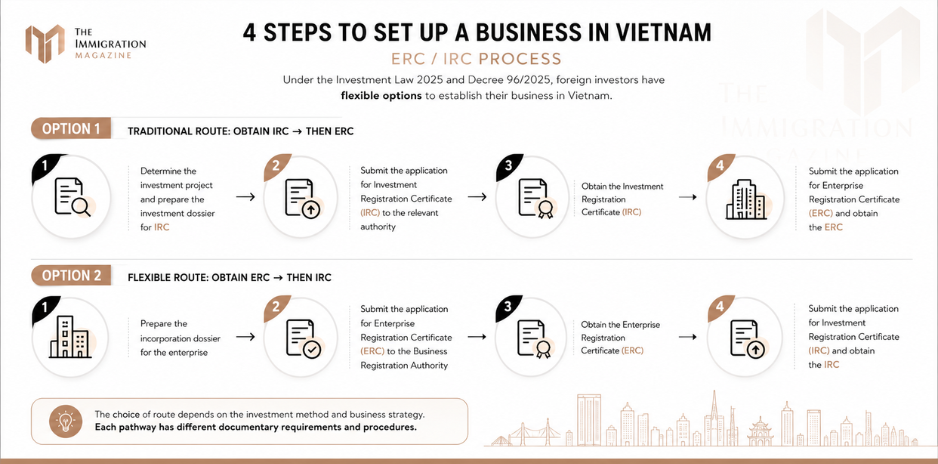
Vietnam’s Law on Investment 2025, effective from March 1, 2026, represents an important step in the modernization of the country’s investment framework. One notable development is the restructuring of licensing procedures that allows certain foreign investors to establish corporate entities before obtaining investment registration approvals, depending on market access conditions and sector-specific requirements.
The reform aims to simplify administrative procedures while increasing the importance of post-establishment compliance, operational transparency, and proper record management. In practice, this creates a more streamlined environment for investors with transparent ownership structures, proper compliance systems, and long-term operational substance.
At the same time, Vietnam continues to maintain conditional sectors and foreign ownership restrictions in sensitive industries. For serious investors, understanding these regulatory boundaries remains essential.
Vietnam’s Position in Global Supply Chain Realignment
Global supply chains are undergoing structural transformation.
Rising geopolitical tensions, export controls, and concentration risks have encouraged multinational corporations to diversify manufacturing and sourcing operations across Asia. Vietnam has become one of the key beneficiaries of this shift.
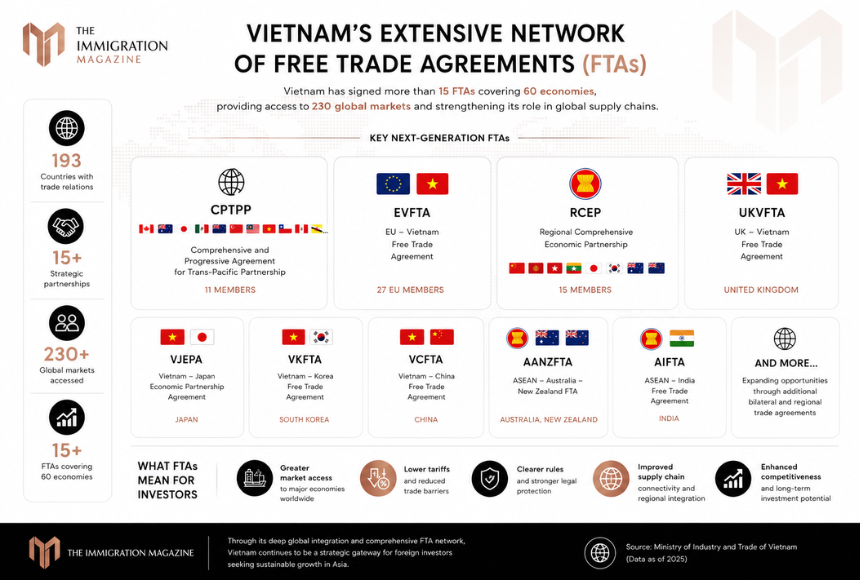
The country’s strategic location near major Asian supply chains, combined with participation in large trade agreements such as CPTPP, EVFTA, and RCEP, has strengthened Vietnam’s role as a regional manufacturing and export platform. For global investors, these agreements improve market connectivity and support broader international trade integration.
Increasingly, Vietnam is being viewed not only as a production base, but also as an important node within broader regional supply chains.
Infrastructure Expansion and Industrial Development
Vietnam is also investing heavily in long-term infrastructure development.
Government-backed projects involving deep-sea ports, logistics corridors, renewable energy systems, industrial parks, and transportation infrastructure are intended to support higher-value industrial activity and stronger regional connectivity.
Major port systems such as Lach Huyen and Cai Mep continue to expand capacity as Vietnam strengthens its export-oriented economy. Although infrastructure challenges remain in some regions, ongoing public and private investment is helping narrow operational gaps that previously limited advanced industrial expansion.
The Rise of High-Tech Investment
Vietnam’s investment profile is evolving beyond labor-intensive manufacturing.
In recent years, the country has increasingly positioned itself within semiconductor-related manufacturing, electronics supply chains, automotive electrification, renewable energy, data centers, and digital infrastructure. The Vietnamese government has repeatedly emphasized the importance of attracting high-tech industries, technology transfer, green investment, and knowledge-based sectors rather than focusing exclusively on low-cost assembly operations.
For global businesses and HNWIs, this transition is significant because higher-value industrial ecosystems often create stronger long-term economic resilience and deeper commercial integration.
FTSE Russell Upgrade: An Institutional Signal
Vietnam’s financial market development has also attracted international attention.
FTSE Russell’s decision to upgrade Vietnam to Secondary Emerging Market status, effective from September 2026, represents an important institutional milestone for the country’s capital markets. The upgrade reflects years of reforms aimed at improving liquidity, market accessibility, settlement systems, and investor participation frameworks.
For institutional investors and wealth managers, emerging market classification can increase global visibility and encourage greater participation from international funds tracking benchmark indices. More importantly, it signals growing international confidence in the development of Vietnam’s financial architecture.
What Investors Still Need to Understand
Despite strong momentum, Vietnam remains a developing market with operational complexities that investors must evaluate carefully.
Challenges may still include administrative inconsistencies, licensing procedures, infrastructure bottlenecks, land-related issues, compliance obligations, and talent competition in high-tech sectors. As a result, successful investment strategies require local regulatory understanding, proper due diligence, long-term planning, and strong operational governance.
For serious investors, Vietnam should not be approached solely as a short-term growth story, but as a strategic long-term positioning market.
Final Thoughts
Vietnam’s attractiveness in 2026 is not based on one factor alone.
Its appeal comes from the convergence of strategic geography, supply chain diversification, trade integration, regulatory modernization, infrastructure expansion, and high-tech industrial development.
As global capital becomes increasingly selective, countries are competing not only for investment volume, but for strategic and long-term capital. Vietnam’s evolving investment environment suggests that it is positioning itself to compete for exactly that type of investment.
For HNWIs, family offices, and global businesses, Vietnam is increasingly viewed not simply as an emerging market, but as a strategic platform for regional resilience, diversification, and long-term growth.
Follow us on social media and website for more insights!