


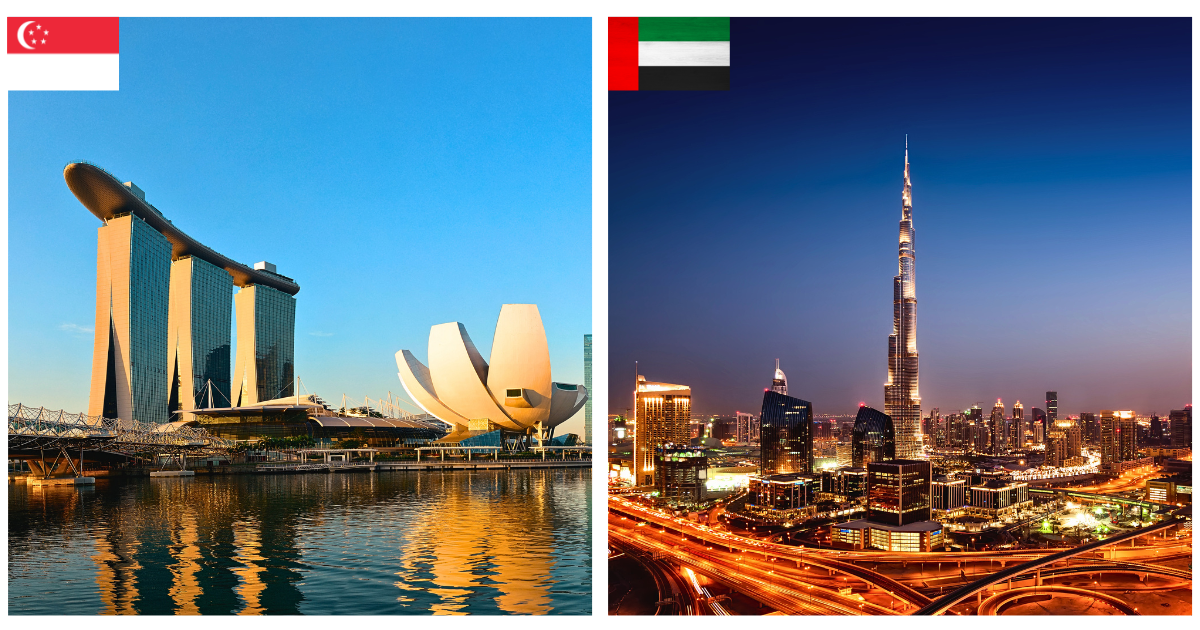
The global family office landscape has become increasingly international over the past decade. As ultra-high-net-worth individuals (UHNWIs) diversify assets across multiple jurisdictions, the choice of where to establish a primary family office has become a strategic decision rather than simply a tax consideration.
Among the world’s leading wealth management centres, Singapore and Dubai have emerged as two of the most prominent destinations. While Singapore has long been recognised as Asia’s principal wealth management hub, Dubai has experienced rapid growth as a gateway connecting Europe, the Middle East, Africa, and South Asia.
Both jurisdictions offer sophisticated legal frameworks, attractive tax regimes, and dedicated ecosystems for private wealth. However, they serve different investment strategies, geographic priorities, and family office structures.
This article compares Singapore and Dubai across regulation, taxation, investment access, residency, and operational considerations to help investors determine which jurisdiction best aligns with their long-term objectives.
1. Geographic Positioning and Investment Focus
One of the most significant differences between Singapore and Dubai is the regional markets they naturally serve.
Singapore: Gateway to Asia-Pacific
Singapore has established itself as one of Asia’s leading international financial centres. Many family offices headquartered in Singapore allocate capital across Southeast Asia, Greater China, Australia, and other Asia-Pacific markets.
Its ecosystem is particularly attractive for investors focused on:
- Venture capital
- Private equity
- Technology
- Healthcare
- Manufacturing
- ASEAN growth markets
Singapore also provides access to a mature banking system, deep capital markets, and an extensive network of professional service providers.
Dubai: Gateway to the Middle East, Africa, and South Asia
Dubai occupies a strategic position between Europe and Asia, making it a natural base for investors operating across the GCC, India, Central Asia, and Africa.
The city’s financial ecosystem has expanded significantly in recent years, supported by the Dubai International Financial Centre (DIFC) and Abu Dhabi Global Market (ADGM). These jurisdictions have attracted growing numbers of international family offices, investment firms, and private wealth advisers.
Dubai is particularly attractive for investors active in:
- Middle East private equity
- Real estate
- Infrastructure
- Private credit
- Cross-border trade
- Energy investments
2. Regulatory Environment and Tax Framework
Although both jurisdictions provide internationally recognised legal systems, their regulatory philosophies differ.
Singapore: Higher Entry Standards with Institutional Certainty
Singapore’s family office ecosystem is built around a highly regulated framework supervised by the Monetary Authority of Singapore (MAS).
Many family offices apply for tax incentives under the Section 13O and Section 13U schemes, which provide tax exemptions on specified investment income when qualifying conditions are satisfied.
Depending on the scheme, these conditions may include:
- Minimum Assets Under Management (AUM)
- Local business spending requirements
- Employment of investment professionals
- Ongoing compliance with MAS expectations
While these requirements create a higher entry threshold, they also contribute to Singapore’s reputation for regulatory certainty and institutional credibility.
Dubai: Flexible Structures and Competitive Tax Environment
Dubai offers a more flexible regulatory environment through jurisdictions such as DIFC and ADGM.
The UAE introduced a federal Corporate Tax regime in 2023. However, depending on the legal structure and whether specific qualifying conditions are met, certain entities operating within free zones may benefit from preferential tax treatment.
Unlike Singapore, Dubai generally does not impose statutory minimum AUM requirements simply to establish a family office or family foundation, making it more accessible for families with a wider range of asset sizes.
Both DIFC and ADGM operate under English common law principles and provide established legal structures for foundations, trusts, and wealth succession planning.

3. Comparing Singapore and Dubai
Factor | Singapore | Dubai |
Primary investment focus | Asia-Pacific | Middle East, India, Africa, Europe |
Regulatory approach | Highly regulated | More flexible |
Family office tax incentives | Section 13O / 13U | DIFC & ADGM structures |
Corporate tax | 17% standard rate with available exemptions for qualifying structures | UAE Corporate Tax regime with potential free zone benefits where conditions are met |
Minimum AUM for tax incentive schemes | Required under 13O / 13U | No equivalent statutory minimum for basic family office establishment |
Legal system | English common law | English common law within DIFC & ADGM |
Residency options | Global Investor Programme (GIP) | UAE Golden Visa |
Wealth management ecosystem | Extensive banking and investment management network | Rapidly expanding international wealth centre |
4. Which Jurisdiction May Be More Suitable?
There is no universal answer. The appropriate jurisdiction depends on a family’s investment profile, geographic focus, and long-term objectives.
Singapore may be more suitable if you:
- Invest primarily across Asia-Pacific.
- Require access to institutional asset managers and sophisticated capital markets.
- Intend to build a long-term governance structure with robust regulatory oversight.
- Can comfortably satisfy the qualifying requirements for Singapore’s tax incentive schemes.
Dubai may be more suitable if you:
- Invest across the Middle East, India, Africa, or Europe.
- Prefer greater operational flexibility and potentially lower establishment costs.
- Have significant exposure to real estate, private credit, or regional operating businesses.
- Value integrated residency options alongside wealth structuring.

5. Beyond Tax: Other Strategic Considerations
While tax efficiency is often discussed, it is rarely the only reason family offices choose a jurisdiction.
Other important factors include:
- Political and regulatory stability
- Access to international banking services
- Availability of experienced legal and tax advisers
- Education and healthcare for family members
- International flight connectivity
- Time zone alignment with key investment markets
- Succession and estate planning infrastructure
These practical considerations often have a greater long-term impact than marginal differences in tax treatment.
Conclusion
Singapore and Dubai have each developed into leading international family office jurisdictions, but they serve different strategic purposes.
Singapore remains a preferred choice for families seeking a highly regulated environment with deep access to Asia-Pacific investment opportunities and a mature financial ecosystem. Dubai, meanwhile, offers increasing flexibility, strong regional connectivity, and an expanding platform for families with interests across the Middle East, Africa, India, and Europe.
Rather than viewing the two jurisdictions as direct competitors, many global families now adopt a multi-jurisdictional approach, using Singapore as an Asia-Pacific governance and investment hub while maintaining a complementary presence in Dubai to support activities across the Middle East and other emerging markets.
Careful evaluation of regulatory requirements, investment objectives, and long-term family priorities remains essential before selecting the jurisdiction that will serve as the foundation of a family office structure.