

Europe, specifically the European Union (EU) and the broader Schengen Area, consistently ranks among the premier destinations for private capital, global family offices, and multinational corporations. The continent’s enduring attraction extends far beyond short-term financial returns; it is anchored in a comprehensive ecosystem defined by capital preservation, institutional stability, and superior quality of life.
As international wealth management moves toward multi-jurisdictional risk mitigation, Europe provides global investors with a rare combination of structural resilience and market access.
This report delivers an institutional analysis of the core drivers compelling international investors to anchor assets and establish residency in Europe.
1. Institutional Governance and Asset Protection

A. Transparent Legal Frameworks and Property Rights
Europe features mature, highly transparent legal systems that provide some of the world’s most stringent protections for private property rights and intellectual property. Unlike emerging markets characterized by sudden policy shifts, the EU operates under a consensus-driven regulatory environment that allows investors to execute multi-decade wealth strategies with exceptional predictability.
B. Reserve Currencies and Financial Infrastructure
- Monetary Stability: The Euro (EUR) and the Swiss Franc (CHF) serve as major global reserve currencies, offering strong purchasing-power preservation against long-term inflationary pressures.
- Capital Depth: Backed by the European Central Bank (ECB) and world-class financial centers (Frankfurt, Zurich, Luxembourg, Paris), Europe offers sophisticated private equity, lombard lending, and family office wealth management infrastructure.
2. Market Scale and Economic Dynamics
A. The EU Single Market
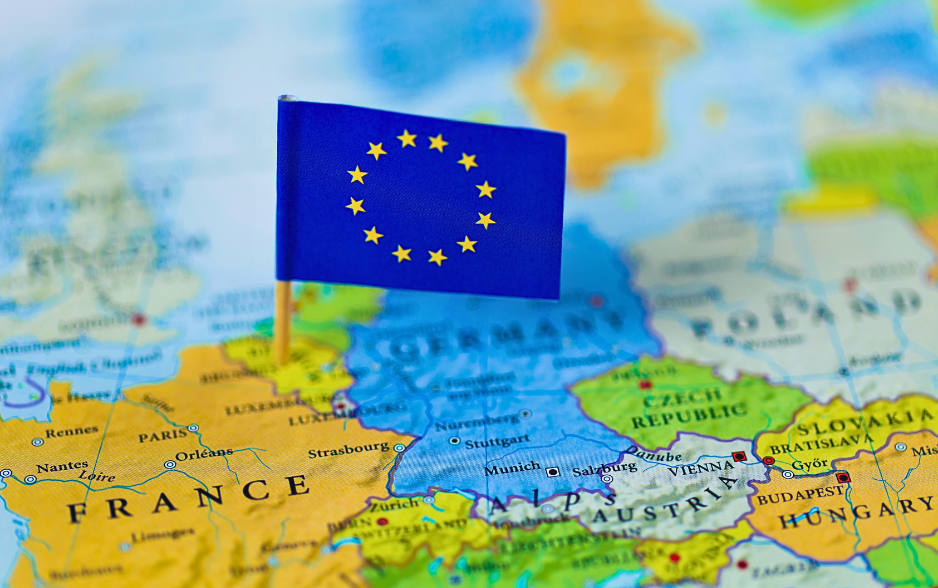
Establishing an operational footprint in one EU member state grants seamless access to the EU Single Market, a unified consumer base of over 450 million people.
- Zero Tariff Barriers: The free movement of goods, services, capital, and labor within the internal market eliminates cross-border trade friction and optimizes supply chain efficiency across member states.
B. Leadership in Green Transition and Innovation
Europe leads global capital allocation toward sustainability and digital transformation. Through multi-billion-euro initiatives supporting clean energy, semiconductors, and artificial intelligence (AI), foreign direct investment (FDI) aligned with Environmental, Social, and Governance (ESG) criteria benefits from substantial state subsidies and green financing frameworks. Furthermore, top-tier research universities across Germany, France, the Netherlands, and Switzerland ensure a steady supply of highly skilled human capital.
3. Strategic Mobility and Residency Advantages (Golden Visas)
For High-Net-Worth Individuals (HNWIs) and family offices, Europe remains a top choice due to its diverse Residence by Investment (RBI) frameworks.
Schengen Area Mobility: Holding a residence permit in a Schengen country allows investors and their immediate family members to travel freely across 29+ participating nations without visa friction.
Evolving Program Frameworks: While program parameters have matured, with several nations shifting away from residential real estate toward private investment funds, innovation funds, or capital contributions, countries like Greece, Italy, Hungary, Cyprus, and Malta continue to offer structured, legally compliant pathways for global families.
4. Strategic Overview: European Investment Advantages
Strategic Dimension | Core European Advantage | Institutional Benefit for Investors |
Capital Preservation | Strong rule of law and reserve currencies (EUR/CHF) | Shields wealth from arbitrary seizure and currency devaluation |
Market Expansion | Access to the EU Single Market (450M+ consumers) | Enables seamless, tariff-free corporate scaling across 27 nations |
Global Mobility | Schengen Area residence permits | Provides operational freedom and travel flexibility for family members |
Future Proofing | Global leadership in ESG and sustainability policies | Unlocks preferential green financing and aligns with future market demand |
5. Risk Factors and Strategic Considerations
To maintain a balanced risk model, global investors evaluating European expansion must account for localized operational dynamics:
- Fiscal Variability: While jurisdictions like Cyprus, Malta, or Bulgaria offer competitive corporate tax rates, tax structures in Western and Northern Europe can be progressive. Cross-border tax planning remains essential.
- FDI Screening and AML Compliance: European financial institutions enforce strict Anti-Money Laundering (AML) and Foreign Direct Investment (FDI) screening guidelines, requiring absolute transparency during initial capital deployment and source-of-funds verification.
Conclusion: The Long-Term European Value Proposition
Europe’s capacity to attract global private wealth and enterprise capital reflects a mature economic model that balances market opportunity with institutional security. While navigating localized tax frameworks and compliance standards demands careful planning, establishing a footprint in Europe provides an insulated, legally transparent anchor for multi-generational wealth preservation.